
A website in Toronto costs anywhere from CAD $1,400 for a template to CAD $100,000 for a large custom build, and the quotes you get for the same brief can differ by three times. The range is not the agencies being vague; it is that “a website” describes five different jobs. This guide gives the 2026 numbers by type of site, in Canadian dollars with the source for each, and then the three questions that explain why one quote is CAD $6,000 and the next is CAD $18,000.
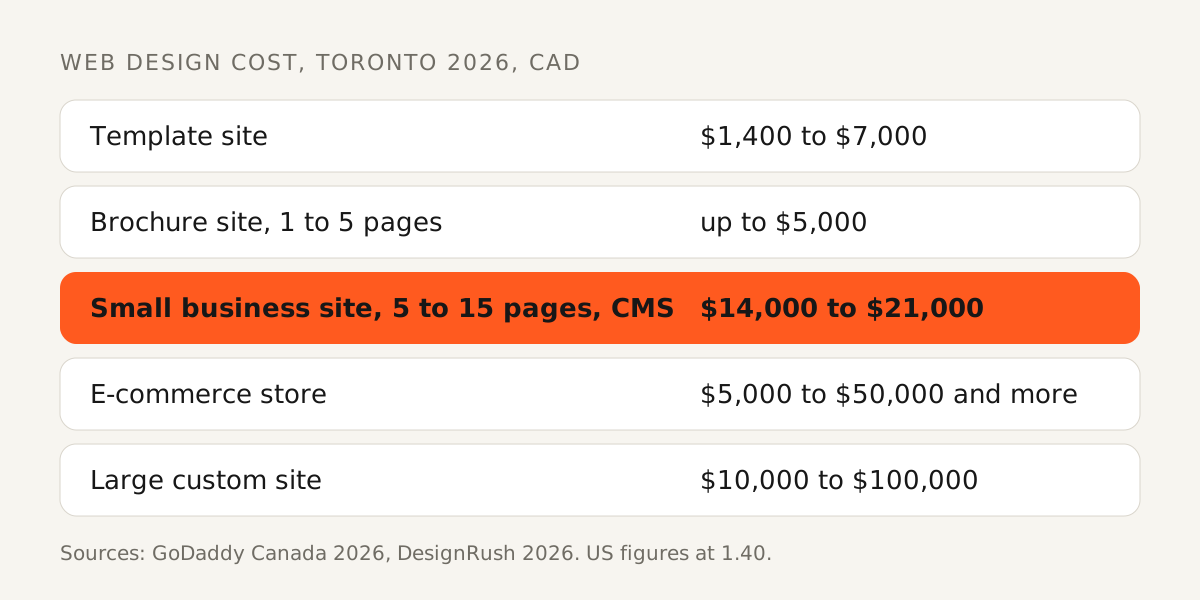
What a website costs in 2026, by type of site
| Type of site | What it is | 2026 range, CAD | Source |
|---|---|---|---|
| Template site | A purchased theme, your logo and text, one to five pages | $1,400 to $7,000 | DesignRush, 2026 |
| Brochure site | One to five pages built by a designer, no custom functions | up to $5,000 | GoDaddy Canada, 2026 |
| Small business site | Five to fifteen pages, a content management system, custom design | $14,000 to $21,000 | DesignRush, 2026 |
| Mid-size site | Fifteen to forty pages, several templates, integrations | $21,000 to $42,000 | DesignRush, 2026 |
| E-commerce store | Small to medium catalogue, payments, shipping | $5,000 to $10,000; large stores $10,000 to $50,000 and more | GoDaddy Canada, 2026 |
| Large custom site | Custom design and functions, many templates, bilingual, integrations | $10,000 to $100,000 | GoDaddy Canada, 2026 |
US figures converted at the Bank of Canada rate of 1.40, November 2026. For a sense of where most projects land: Clutch (2026) reports that most agency web design projects cost under CAD $14,000.
The ranges overlap because the type of site is only the first of three things that set the price.
The three things that set the price
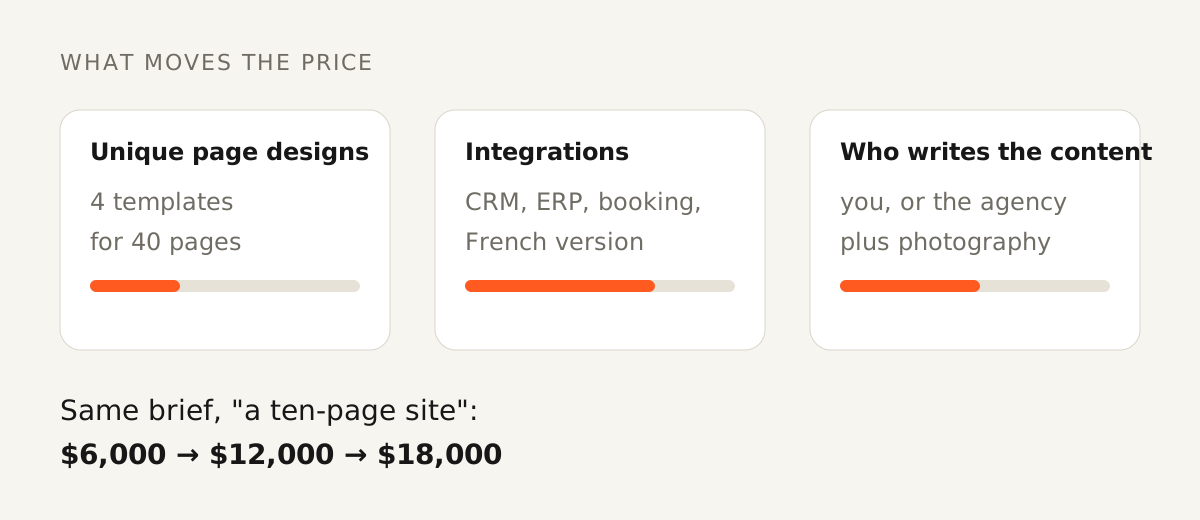
The first is the number of unique page designs, not the number of pages. A forty-page site with four templates (home, service, article, contact) is a four-template job; a twelve-page site where every page is designed from scratch is a twelve-template job and costs more. When a quote feels high for the page count, this is usually why.
The second is what the site connects to. A quote request that lands in your inbox is standard. A quote request that creates a lead in your CRM, a product catalogue fed from your ERP, a booking calendar, a members’ login, or English and French versions of every page are each a separate line, and each can add thousands.
The third is who writes the content. Design and content are the two most underestimated line items in a web project (DesignRush, 2026), and content is the usual reason a site that was quoted for ten weeks launches in twenty. If the agency writes it, it is in the price; if you write it, the price is lower and the schedule is yours to keep.
Why three quotes for one site differ by three times
Take a Toronto company that asks three agencies for “a ten-page site with a contact form”.
The first quotes CAD $6,000: a purchased theme, your text pasted in, the form sends an email. The second quotes CAD $12,000: four custom templates, the form goes to your CRM, you write the text. The third quotes CAD $18,000: the same four templates, the text written and the photos taken, a redirect map for the old site, and the first three months of care included.
None of the three is overcharging. They quoted different jobs, because the brief did not say which job it was. Before you compare prices, make the three quotes describe the same work: how many templates, which integrations, who writes, what happens after launch.
What is usually left out of the quote
Four things are often missing from a web design quote and appear later as invoices: the content, the photography, the care plan, and the redirects.
The care plan is the one to pin down before you sign. Small-business website maintenance runs CAD $70 to $700 a month (GoDaddy, 2026), and a build quoted low with a high monthly fee costs more over three years than the reverse.
The redirects matter if you already have a site. Every old address that brings traffic or carries a link needs a redirect to its new home before launch, or the rankings you spent years earning go with the old site. Ask every agency how they handle it; an answer that does not mention a list of old addresses is an answer that will cost you traffic. Keeping what still ranks is the first deliverable of our website redesign service, because it is the question we are asked most.
How long it takes
A professionally built site takes ten to fourteen weeks from planning to launch (Forbes Advisor, 2024). DesignRush (2026) gives two to three weeks for a CAD $7,000 site and ten to fourteen weeks for a CAD $35,000 one, and warns that rush work adds 25 to 50 percent and scope overruns add 5 to 30 percent.
Most of the difference between a ten-week project and a twenty-week one is content that was not ready. If the text exists when the brief is signed, the schedule holds.