
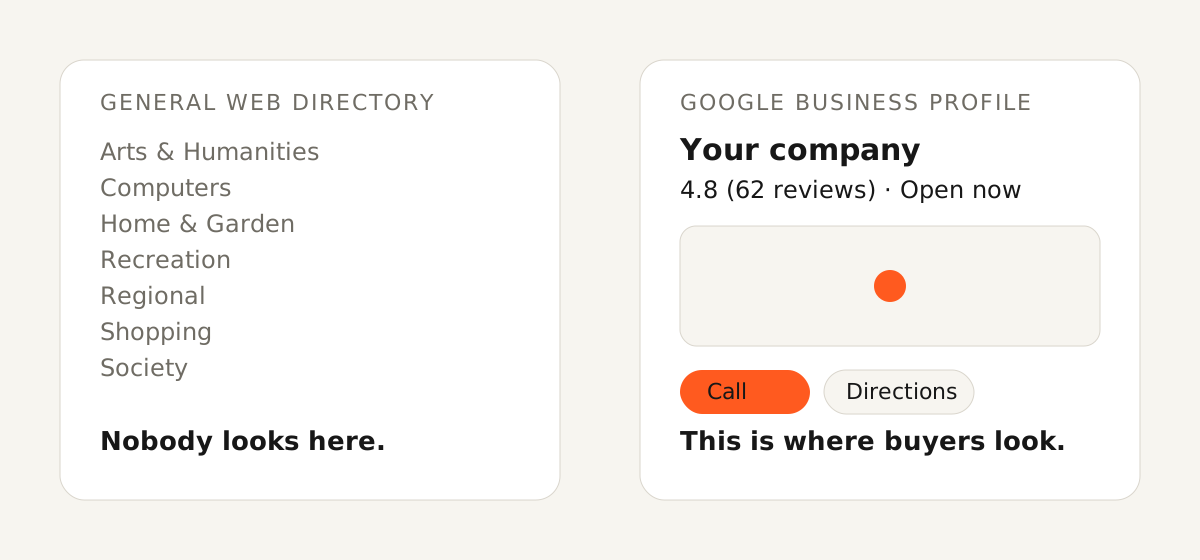
If your business is on more than eight directories, most of them are doing nothing. A web directory is a list of websites sorted by category, and in 2026 only the ones your customers actually open are worth your time. The rest cost money, create duplicate listings with the wrong phone number, and in the worst case count against you.
What a web directory is, and what it used to be
In the late 1990s, before search engines were good, a directory was how you found a website. Yahoo started as one. Editors sorted sites into categories by hand, and being listed meant being found.
Search caught up, the editors left, and the general directories either closed or became places that sell listings to people who do not know they closed in spirit. What survived is narrower and more useful: lists kept by organizations your customers already trust.
So when an owner in Mississauga asks whether to be in “the directories”, the honest answer is a question back: which directories do your buyers open?
Why general directory links stopped counting
Google’s own spam policies list “directory or bookmark site links” that exist mainly to manipulate ranking as link spam, alongside bought links and link exchanges (Google, 2026). A listing on a directory nobody reads is exactly that kind of link.
That does not make every directory link harmful. A link from your industry association’s member page is a normal link from a real organization. The test Google applies is intent: was the listing made for people, or for the crawler?
The practical consequence for an owner is simple. A directory is worth joining for the people who use it. If people use it, the link takes care of itself.
The five kinds of directory that still count
| Directory type | Examples for a Toronto business | What it does for you |
|---|---|---|
| Map and business listings | Google Business Profile, Apple Business Connect, Bing Places | Puts you on the map results, with hours, reviews and a call button. The single most-used listing there is. |
| Industry associations | Your trade’s provincial or national body, its member directory | Buyers and procurement staff check membership before they call. |
| Local business bodies | Chamber of commerce, BIA, board of trade | Referrals from other members, local credibility, an event calendar. |
| Review sites your buyers read | HomeStars, Clutch, Google reviews, industry-specific review platforms | Decide whether the buyer calls you or the next company. |
| Niche directories with real traffic | A supplier directory in your industry, a regional buyers’ guide | Rank for “supplier of X in Ontario” when your own site does not yet. |
Five to eight listings, all with the same name, address and phone number, cover nearly every business we have worked with since 2002.
How to tell a useful directory from a useless one
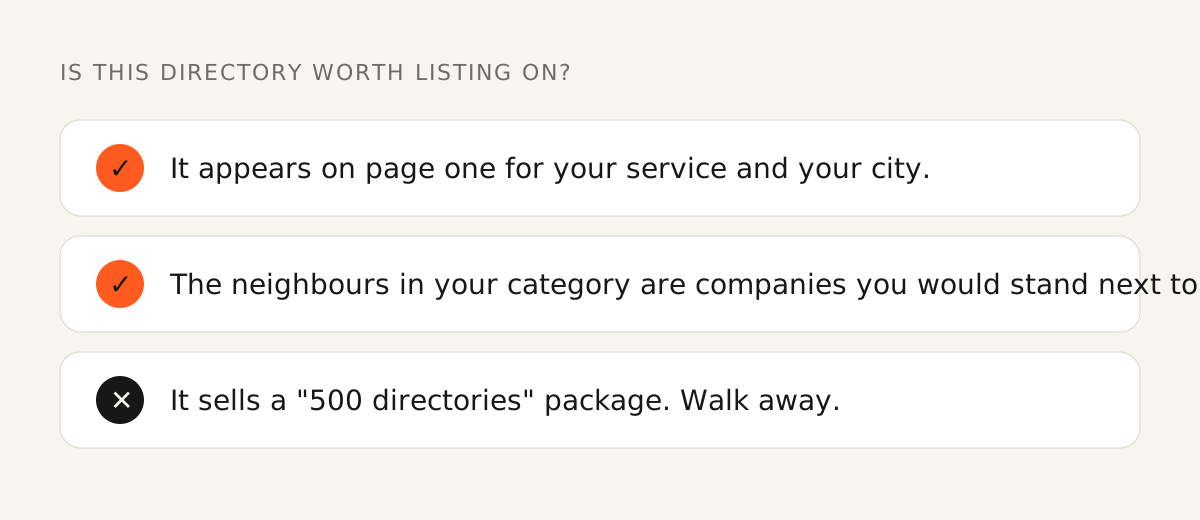
Search Google for what you sell and your city. If a directory shows up on the first page, your buyers see it, and a listing there is worth having.
Then open the category where you would sit and read the neighbours. On a useful directory they are companies you would be happy to be compared with. On a useless one they are twenty pages of unrelated sites, half of them dead.
Last, look at the price. A chamber membership or an association fee buys a listing people read, plus the events and referrals that come with it. A “submit your site to 500 directories for $49” package buys the opposite.
What to do with the listings you already have
Most companies have more listings than they remember making. A former employee set one up, a marketing company created forty, a directory copied your details from another directory.
Search your business name plus your phone number, and your name plus your old address if you have moved. Every listing that shows an old number or a closed location is a customer who gets a dead line. Claim the ones on the useful directories, fix the details, and leave the rest; a listing on a dead directory is not worth the hour it takes to remove.
Keep one file with the exact name, address, phone, hours and the one-paragraph description you use everywhere. Consistency across listings is what the map results reward, and it is what stops the duplicate-listing problem from coming back.