
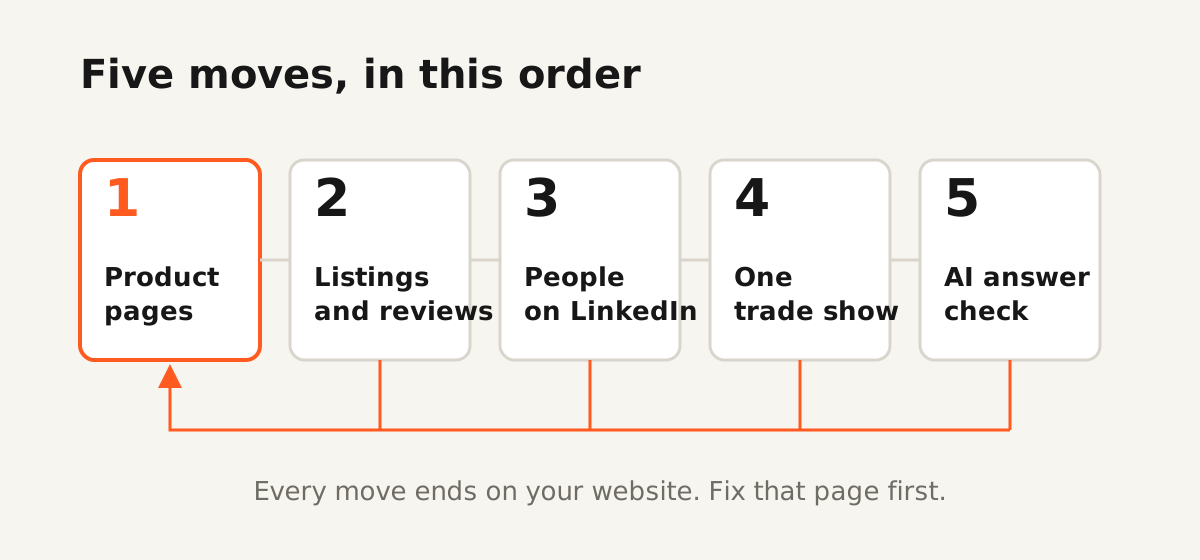
Marketing for a manufacturer with 50 people and no marketing department comes down to five moves done in order: product pages an engineer can actually use, listings where buyers look you up, the owner and the reps on LinkedIn, one trade show worked for a full year, and a check of what AI assistants say when a buyer asks about you. The order matters more than the budget, because every move after the first one sends the buyer to your website. Here is the buyer data behind each move and what each one costs in 2026.
Who this is written for
You run a plant in Ontario with 30 to 80 people. Sales is the owner plus a rep or two who have been there fifteen years. New work comes from repeat customers and from people who know people.
That is most of the sector. Of 20,456 manufacturing employers in Ontario, 18,972 have fewer than 100 employees (ISED, 2025).
And this is not an easy year to rely on the usual buyers. 54% of Canadian manufacturers expected a negative impact from US tariffs over the next twelve months, the highest share of any sector (Statistics Canada, 2026). The S&P Global Canada Manufacturing PMI fell to 49.6 in October, the first reading below 50 since December 2025, with new orders dropping at the steepest rate in over a year (PLANT, 2026).
How does an engineer find a supplier in 2026?
Mostly without talking to you. In Gartner’s survey of 645 B2B buyers, 67% said they prefer a buying process without a sales rep, and buyers used an average of seven information sources in a recent purchase (Gartner, 2026). McKinsey’s B2B Pulse, close to 4,000 decision makers in 13 countries, counts ten channels, split roughly evenly between in-person, remote and self-serve (McKinsey, 2026).
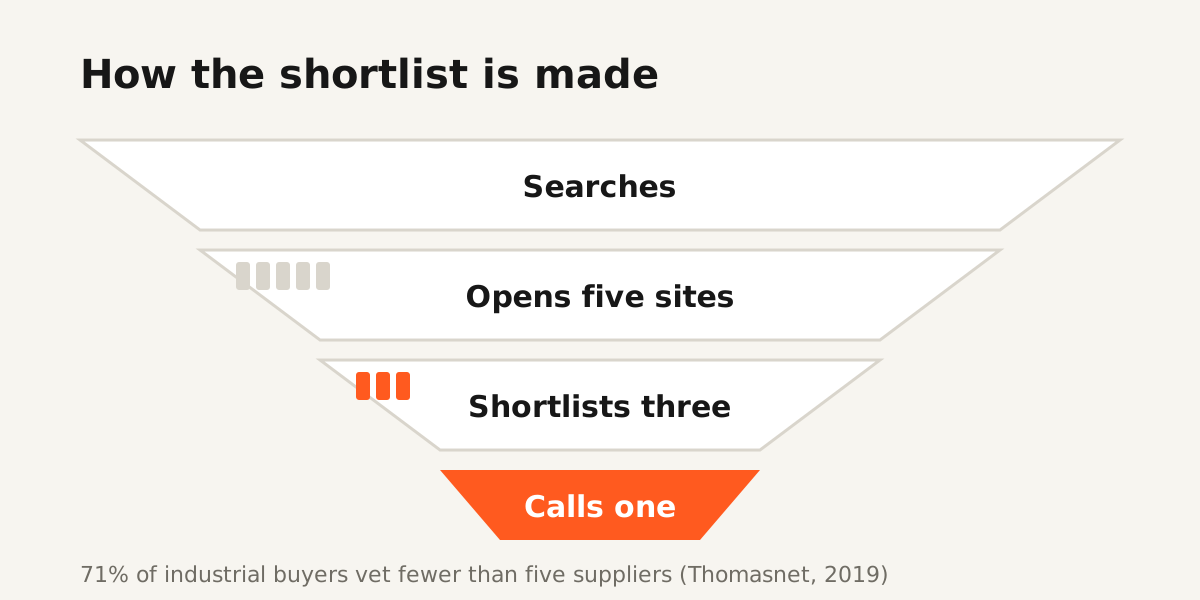
Those surveys skew to large companies. The industrial-only data is older and points the same way: 73% of industrial buyers said they pay close attention to a supplier’s website when evaluating it, and 71% vet fewer than five suppliers before they buy (Thomasnet, 2019).
Put those together. A plant engineer in Cambridge needs a process chiller for a new extrusion line. She searches, opens five sites, cuts the list to three, and only then picks up the phone. If your site does not answer her questions, you are not one of the three.
What should a 50-person plant do, and in what order?
| Step | What you do | Why it comes here | What it costs in 2026 |
|---|---|---|---|
| 1. Product pages | One page per product line: capacities, materials, certifications, lead time, drawings, a quote form that asks about the application | 73% of industrial buyers weigh the website; 71% shortlist under five suppliers (Thomasnet, 2019) | Your engineer’s hours plus a writer; a full redesign is a separate project |
| 2. Listings and reviews | Google Business Profile, the directories your buyers use, association member pages, with the same name, address and product list everywhere | Buyers use seven to ten sources before they call (Gartner, 2026; McKinsey, 2026) | Mostly time; the listings that matter most are free |
| 3. People on LinkedIn | The owner and the reps post once a month: a photo from the floor, what shipped, to whom (with permission) | Up to 95% of buyers are not in the market today and need to remember you later (Ehrenberg-Bass, 2021) | Time; no advertising needed to start |
| 4. One trade show | Pick one show; every contact gets the spec sheet they asked about within five working days | CMTS 2025 drew more than 750 suppliers and expected more than 10,000 visitors (SME, 2025) | The booth price from the organizer, in writing, before you plan |
| 5. AI answer check | Ask ChatGPT and Google’s AI Mode five buyer questions; note who is named and which sites are cited | 45% of B2B buyers used generative AI to research vendors (Gartner, 2026) | An afternoon to do it yourself |
Why does the website come before everything else?
Because every other move ends there. A LinkedIn post, a directory listing, a badge scan at a show, an AI answer: each one finishes with someone opening your site, and the site either answers the engineer’s questions or it does not.
The page that matters is not the home page. It is the product page. A shop in Mississauga that runs five-axis work for aerospace should have a page that says five-axis, the envelope in millimetres, the alloys it has run, AS9100 with the certificate number, and the current lead time. “Precision machining solutions” says none of that, and the engineer closes the tab.
The quote form belongs on that page, not behind a Contact link. Ask for the application, the volume and the date needed. A form that asks only for an email address gets emails from people selling you things.
Should you lead with Made in Ontario?
Only where the buyer has a reason to care. 29.2% of Canadian manufacturers changed their marketing to promote Canadian products in the previous twelve months, nearly double the 16.6% across all businesses (Statistics Canada, 2026).
It works for public procurement, for buyers with their own tariff exposure, and for customers who have been burned on lead times from abroad. On a product page it is a line in the specifications next to the plant address, not the headline. The engineer still needs the capacity figure first.
Does a manufacturer need to be on LinkedIn?
Yes, but not the way it is usually sold. The Ehrenberg-Bass Institute’s rule of thumb, written for the LinkedIn B2B Institute, is that up to 95% of business buyers are not in the market for a given product at any one time (Ehrenberg-Bass, 2021). The author calls it a heuristic, not a measurement, and LinkedIn sells advertising. The logic still holds for a plant.
The engineer who will need a chiller in 2028 is not searching today. She will remember the company whose owner posted the installation photo last spring, because she saw it four times.
So the account that posts is the owner’s or the rep’s, not the company page. One post a month with a photo from the floor and one sentence on what shipped beats a weekly stream of stock images. Nobody buys a heat exchanger from a company page.
Do trade shows still pay?
They pay when they are worked and they are expensive when they are attended. CMTS 2025 in Toronto drew more than 750 suppliers and expected more than 10,000 manufacturing professionals, on a show floor 20% larger than the previous edition (SME, 2025). The buyers are there.
What decides the return is the week after. Every badge scanned gets a short email with the one spec sheet the person asked about, from the person they met, within five working days. A plant that does that from one show a year gets more from it than a plant that does three shows and sends a newsletter in January.
Get the booth price from the organizer in writing before you plan the year around it.
What does marketing cost a manufacturer?
Less than the benchmarks suggest, if you keep the order above. Gartner’s CMO survey puts marketing budgets at 7.7% of revenue in 2025, flat from 2024 (Gartner, 2025). Its respondents are mostly companies with more than USD 1 billion in revenue, and a 50-person plant is not going to spend that share, nor should it.
What you will pay for: a writer who can read a spec sheet, a photographer for a day on the floor, the booth, and, in some niches, an SEO retainer. Across 439 SEO providers in the US and Canada, the most common monthly retainer was USD 501 to 1,000 and the average was USD 2,917 (Ahrefs, 2024).
Before you sign a retainer, ask which exact searches it will win and what the winning page looks like. For most industrial terms the win is being the one page that answers the question, not a campaign.
What about ChatGPT and Google’s AI answers?
Check them before you pay anyone. 45% of B2B buyers used generative AI during a recent purchase, mostly to gather information on vendors and products, and 69% said they prefer to validate what the AI told them with a sales rep (Gartner, 2026). The AI answer is the first list; the rep call is the check. You want to be on the first list.
Ask ChatGPT, logged out with web search on, five questions your buyer would ask. “Industrial chiller manufacturer Ontario.” “Who builds custom conveyors near Hamilton.” Write down every company named and every site cited. If the answers name directories and competitors and never your site, that is where the next hour of work goes, and it is the first thing we look at in our work with manufacturers. The full version of that check across ChatGPT, Perplexity and Google’s AI Mode is our AI Search Visibility audit at CAD 3,500; the five-question version costs you an afternoon.