
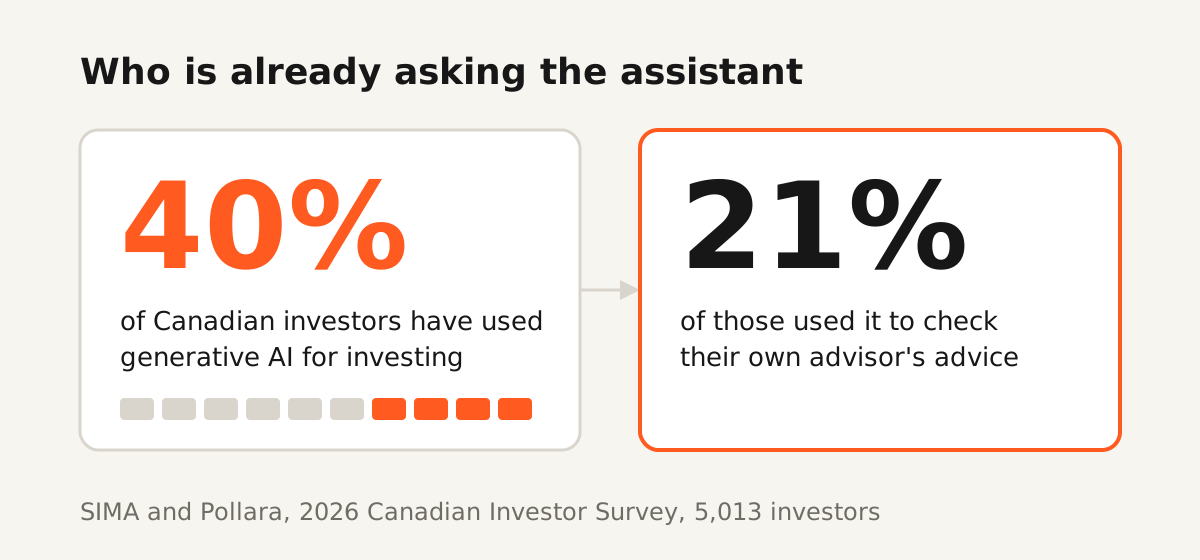
Most wealth firms still judge their marketing by their Google ranking, while 40% of Canadian investors have already asked an AI assistant about investing (SIMA and Pollara, 2026), and nobody at the firm has read what it says about them.
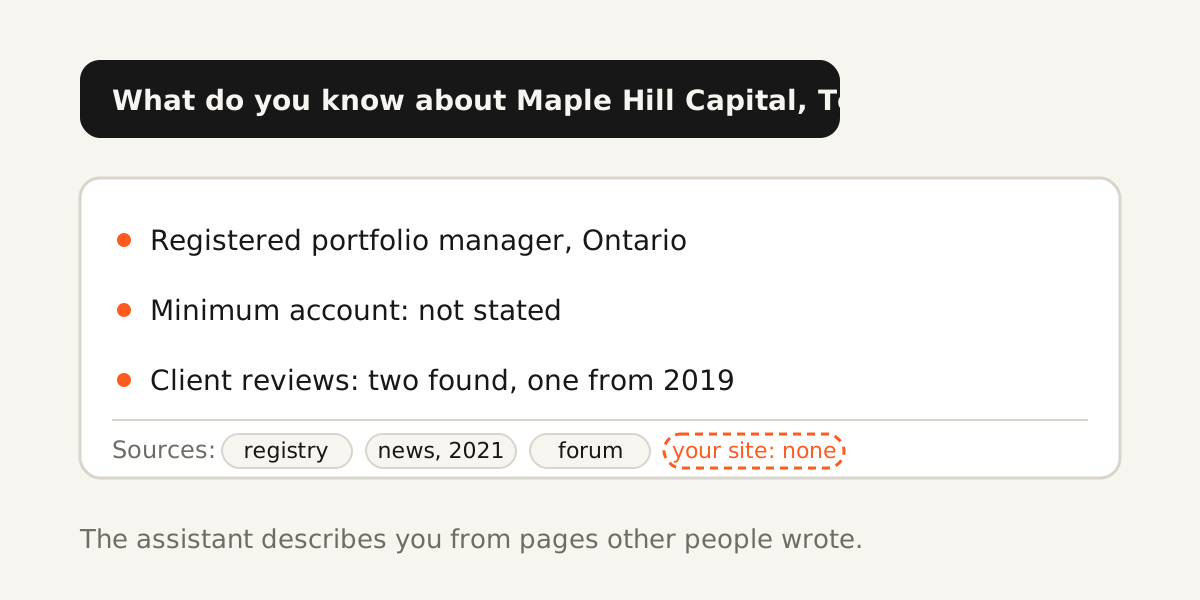
You run an advisory practice in Toronto. A prospect’s daughter hears your name at dinner, and before she calls, she asks ChatGPT about your firm. Financial advisor SEO in 2026 includes that answer, and the first step is to read it yourself.
Who is asking the assistant
In a survey of 5,013 Canadian investors, 40% had used generative AI for investment purposes, and 21% of those used it to check what their own advisor had told them (SIMA and Pollara, 2026). The assistant is not replacing you; it sits in the room before the first meeting.
Half of Quebeckers aged 18 to 24 already use AI for personal finance information (AMF and Léger, 2026). That generation inherits the accounts.
What the assistant reads about you
ChatGPT builds its answer from pages other people wrote. In November 2026, Wikipedia held 10.1% and Reddit 6.2% of the citation share among its 50 most-cited US sources (Ahrefs, 2026).
For a Toronto advisory firm that means the CIRO or OSC registry entry, a Google Business Profile with four reviews and a 2021 news mention. Your own site, written to pass compliance, is often the last thing it cites.
The 20-minute check
Open ChatGPT logged out, with web search on. Ask what a prospect would ask: “Is Maple Hill Capital a registered portfolio manager in Ontario?” “What is their minimum account?” “What do clients say about them?”
Write down what it says and which pages it cites. Hand the list to compliance before marketing; a wrong fact about registration or fees is their problem.
Since November 2026 a firm can claim its listing in OpenAI’s Businesses in ChatGPT beta and see how often it is mentioned and clicked; non-US claims went to a waitlist at launch (PPC Land, 2026). Join it.